Which Mattresses Actually Publish ILD?
In our 13-model Firmness Translation Index dataset, Brooklyn Bedding is the only mattress brand that publishes ILD (Indentation Load Deflection) figures — across three products — while every other brand in the dataset shows "Not disclosed." The three with real numbers: the Signature Hybrid (per-layer ILDs of roughly 13, 18, and 28), the Plank Firm (published 36 ILD core and 28 ILD fast-response layer), and the brand's soft Talalay latex topper (comfort ILD 19 in a 19/28/36 lineup).
ILD is the objective measure behind foam firmness; a brand's 1-10 number is self-assigned marketing. No prices or ratings on this site — construction and disclosure facts only.
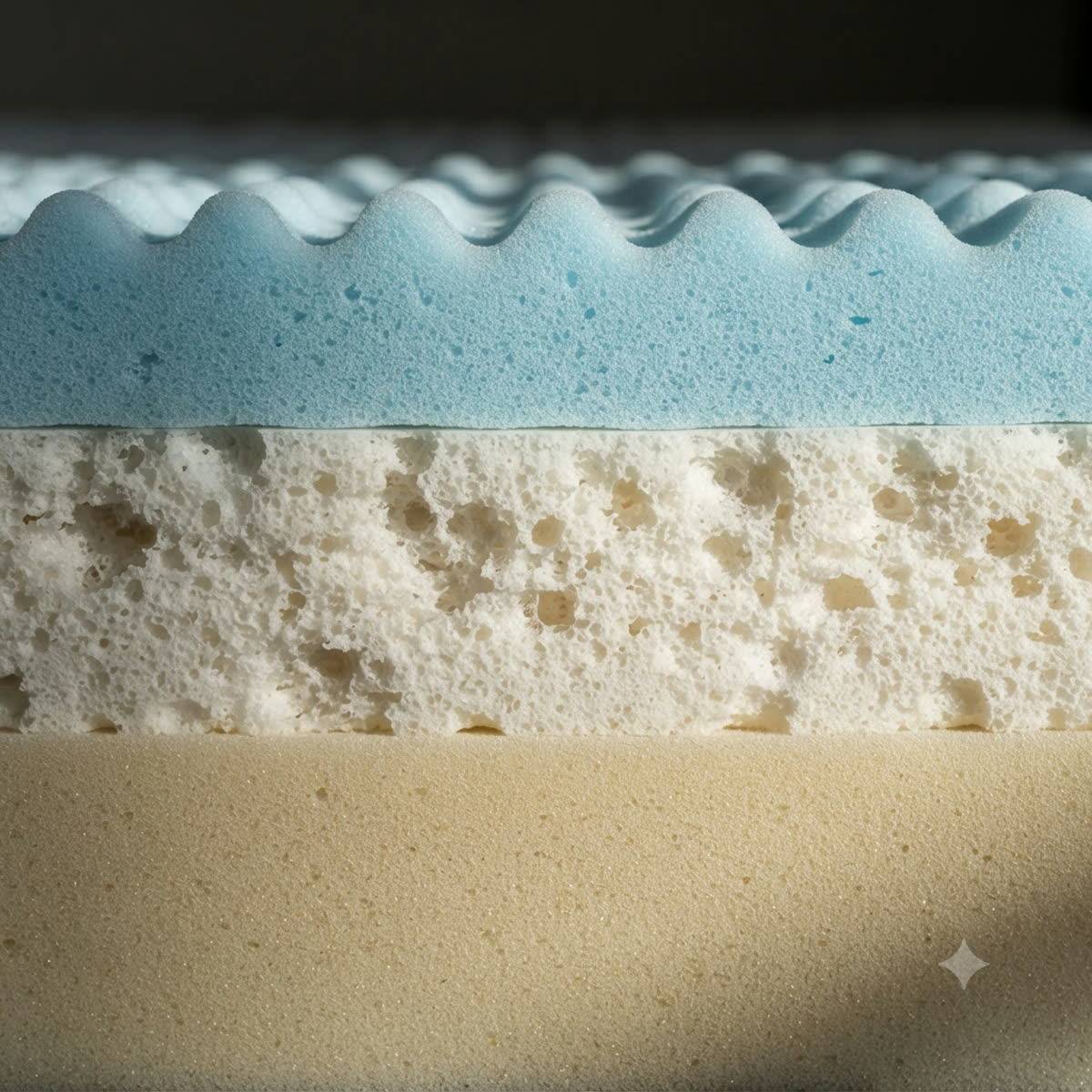
If you want a firmness claim you can verify rather than take on faith, disclosure is the whole game. ILD is a defined industry test, but publishing it is voluntary — and almost nobody does. Below are the only three products in our dataset with manufacturer-published ILD, each linking to a live tagged Amazon search.
The one thing to know: ILD (Indentation Load Deflection) is a defined foam-industry test: the force, in pounds, needed to compress a standard 15"x15"x4" foam sample by 25% of its thickness using a 50-square-inch circular indenter (ASTM D3574 for polyurethane foam; latex is commonly tested under a related but distinct protocol). Higher ILD means firmer foam. The catch: almost no mattress brand publishes it, because unlike a self-reported '1-10' label, ILD is a verifiable number a buyer could use to compare brands directly — which is exactly why its absence is itself the story.
The picks with published ILD
Brooklyn Bedding Signature Hybrid
Hybrid (foam comfort layers + pocketed coil core), self-reported 'Medium' tier of a Soft/Medium/Firm lineup, manufacturer-published layer ILDs (quilt ~13, TitanFlex ~18, transition ~28)
Publishes ILD numbers for multiple internal layers, not just a single headline figure — the most transparent spec sheet in this dataset.
Best for: Combination sleepers (back/side) wanting a documented middle-of-the-road feel with real coil support
Watch out: Even with published ILD, Brooklyn Bedding's own firmness label ('Medium') is still self-assigned — always cross-check the ILD numbers themselves, not just the word.
Check price on AmazonBrooklyn Bedding Plank Firm (Firm side)
All-foam flippable mattress, manufacturer-published core spec 1.8 lb density / 36 ILD with a 3.5 lb / 28 ILD fast-response layer, self-reported 'Firm' with a firmer 'Ultra-Firm' flip side
One of the very few firm-tier mattresses with an actual published ILD number for both major foam layers, not just a marketing label.
Best for: Stomach sleepers, heavier-body-weight sleepers, or anyone who specifically wants a verifiable firm spec rather than a brand's subjective 'firm' claim
Watch out: All-foam construction sleeps warmer than a coil-based firm mattress, and the flippable dual-firmness design means the 'other side' is even firmer than most shoppers expect from the word 'firm.'
Check price on AmazonBrooklyn Bedding 3" Latex Topper — Soft
Natural Talalay latex topper, manufacturer-published comfort ILD 19 (soft tier of a 19/28/36 lineup), 3 in thickness
A rare case where the brand actually publishes the ILD number on the spec sheet, so you can compare it directly to their own medium (28 ILD) and firm (36 ILD) versions.
Best for: Side sleepers wanting to soften an existing firm mattress rather than replace the whole bed
Watch out: A topper only changes the top few inches — it doesn't change the support core underneath, so a very firm base can still feel firm through a soft topper for heavier sleepers. Note this specific topper is not currently listed on Amazon (the brand sells mattresses there, but we could not find this topper), so buying it means going direct; the link below shows comparable soft Talalay latex toppers available on Amazon.
Check price on AmazonWhy disclosure is so rare
Most mattress brands publish a firmness label or 1-10 number but not the underlying ILD for any layer. When a brand DOES publish ILD (as Brooklyn Bedding does for several product lines), it's usually because the brand also sells raw foam/components to a more technical buyer audience, not because of any industry requirement. The absence of ILD on a spec sheet doesn't mean a mattress is low quality — it means the firmness claim can't be independently verified against another brand's claim.
The caveat: ILD isn't comparable across materials
Identical ILD numbers feel different depending on construction. Memory foam has a slow, viscoelastic recovery that deepens the sink-in feeling at a given ILD; latex responds quickly and feels more buoyant at a comparable ILD; a hybrid's coil support core adds bounce and can make a soft comfort layer feel more supportive than the same foam over an all-foam base. So ILD is only directly comparable within similar constructions — a 28-ILD latex layer and a 28-ILD memory-foam layer will not feel the same.
Frequently Asked Questions
In our 13-model Firmness Translation Index dataset, Brooklyn Bedding is the only brand that publishes ILD figures, across three products: the Signature Hybrid (per-layer ILDs of roughly 13, 18, and 28), the Plank Firm (36 ILD core, 28 ILD fast-response layer), and its soft Talalay latex topper (comfort ILD 19). Every other brand in the dataset shows 'Not disclosed.'
ILD (Indentation Load Deflection) is a defined foam-industry test: the force, in pounds, needed to compress a standard 15"x15"x4" foam sample by 25% of its thickness using a 50-square-inch circular indenter, specified for polyurethane foam under ASTM D3574. Higher ILD means firmer foam.
Brands that publish ILD are usually ones that also sell raw foam or components to a more technical buyer audience — there is no industry requirement to disclose it. A subjective 1-10 label can't be contradicted; an ILD figure is a specific, checkable number.
No. The absence of ILD on a spec sheet doesn't mean the mattress is bad — it means the firmness claim can't be independently verified against another brand's claim. You're relying on the brand's own label rather than a measurable spec.